Surveillance Radar Market Outlook Report 2025-2034
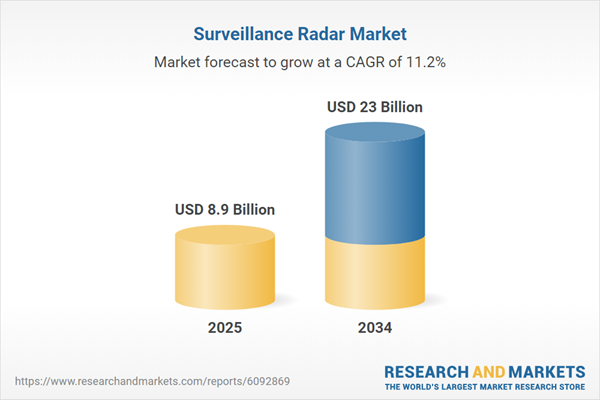

The global surveillance radar market is set to surge from USD 8.9 billion in 2025 to USD 23 billion by 2034, with a CAGR of 11.2%. Key growth drivers include advanced AI-integrated radars, rising geopolitical tensions, and increased mobile unit demand for military and civilian applications. AI, sensor fusion, and AESA technologies are transforming radar capabilities. Heightened focus on cybersecurity and sustainability is prompting innovations in radar designs. With major expansions in maritime and aerial surveillance, this thriving market offers significant opportunities for strategic investment and development.
Surveillance Radar Market
Dublin, July 30, 2025 (GLOBE NEWSWIRE) — The “Surveillance Radar Market Outlook 2025-2034: Market Share, and Growth Analysis By Component (Antennas, Transmitters, Power Amplifiers, Receivers, Duplexers, Digital Signal Processors, Other Components), By Radar Type, By Platform, By Application” has been added to ResearchAndMarkets.com’s offering.
The surveillance radar market is poised for rapid growth, expected to soar from USD 8.9 billion in 2025 to USD 23 billion by 2034, at a CAGR of 11.2%. This sector plays a pivotal role in defense, border control, and airspace management, leveraging radar systems for tracking and monitoring across various terrains. This demand is fueled by geopolitical tensions, defense spending, and both civil and military applications.
Technological advancements are at the forefront, with innovations in digital signal processing, active electronically scanned array (AESA) technology, and sensor fusion capabilities driving performance. Surveillance radars are crucial in providing real-time visibility and decision-making support worldwide, whether in military bases or urban security grids.
Noteworthy developments in 2024 have accelerated defense modernization in regions like North America, Asia-Pacific, and Europe, with investments in integrated radar systems. This has led to a rise in demand for mobile radar units, especially in conflict-prone zones, driven by advancements in AI for improved target classification and reduced false alarms.
Maritime surveillance responds to threats such as illegal fishing and piracy, while civilian air traffic controls upgrade to manage rising aircraft traffic. The shift toward unified, interoperable networks is evident as radar data integration into multi-domain platforms becomes widespread.
The industry is poised to evolve with network-centric warfare and autonomous defense technologies. Future systems will focus on modularity, scalability, and reduced size, weight, and power (SWaP). AI and machine learning integration will enhance autonomous operations and adaptive threat prioritization. Space-based and airborne radar capabilities will expand for persistent monitoring.
link