


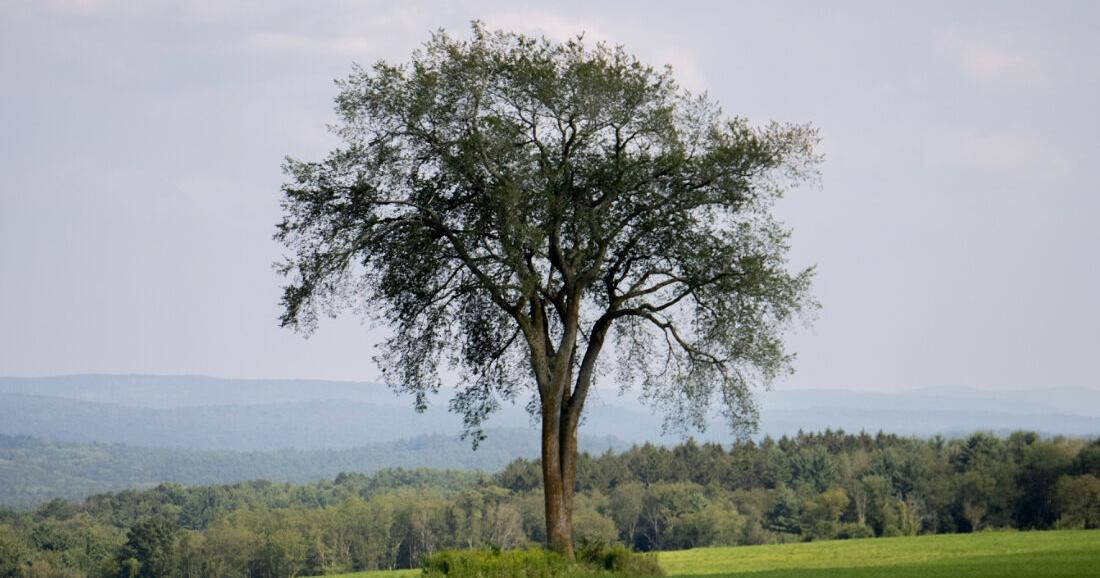
EGREMONT — Berkshire County’s most photographed tree got a special injection Friday morning to protect it from Dutch elm disease.
Early Friday, before the daily heat could set in, a crew from Sheffield-based Bartlett Tree Experts drilled small holes throughout the base of the Baldwin Hill Elm, directly injecting it with a solution that will travel up the trunk and through the leaves.
“It’s tapped into the vascular system for the tree to essentially draw up like a straw,” arborist Kieran Yaple said.
Set alone against a mountainous backdrop in Egremont, the twin-trunked heritage elm stands nearly 100 feet above sloping farm fields and is estimated to be about 140 years old. Known as the Baldwin Hill Elm, the picture-perfect tree has been protected since 1999 as part of the “Adopt an Elm” program by Elm Watch, founded by Tom Zetterstrom, a Connecticut-based photographer and conservationalist.
The American elm, which is Massachusetts’ state tree, once made up 75 percent of the trees that lined New England’s streets, according to Zetterstrom, but nearly all have been destroyed by Dutch elm disease, which arrived in the 1940s. Spread by elm bark beetles, the disease has killed millions of trees worldwide.
Trees protected through the program typically receive a treatment every three years, but the Baldwin Hill Elm missed its last treatment, so it received a “therapeutic dose” carrying a higher concentration of the fungicide propizol. In June, it will receive a follow-up treatment with Arbotect, which is also a fungicide it is given every two to three years.
The entire process took about two hours, but a regular treatment can take much longer.
Several small tees are placed around the Baldwin Hill elm tree Friday morning to help evenly distribute the fungicide solution.
“The idea is that it will remain in the system for two to three years, which is why we’ll re-treat it every two or three, and that way, if we have elm bark beetle, which is what carries Dutch elm disease, it just won’t pick up that disease,” Yaple said.
“A good analogy is, ‘Oh, we’re bleeding heavily, let’s stitch it up’ and then in June, ‘It’s going great, we’ve healed, now we just need to keep kind of a slow, more drawn-out approach,’” Yaple said.
The amount of solution needed depends on the diameter of the tree. Since this one is 52 inches, the special treatment included about 6 gallons of propizol, but when the crew returns for a regular treatment in June, it will be about 60 to 70 gallons.
Before the injection could begin, the area had to be prepped for drilling by cleaning it up a bit. Then workers had to drill in the plastic pieces to guide the liquid into the tree. They first run water through the system to ensure there is no leakage and then add the solution. A finishing dose of water is sent through to ensure all the solution has made it into the tree.
Bartlett Tree Expert workers remove the taps from the Baldwin Hill elm after injecting the tree with fungicide.
Over the years, it’s estimated that thousands of dollars have been donated to this tree based on materials and time for treatments. The cost of a treatment ranges from $30 to $45 per inch. A treatment for this elm would be an estimated $2,000 each year.
“Thousands of elms have been saved over the years with this approach and this treatment all over the country,” Yaple said.
Of all the trees he works to keep healthy, this one is fairly popular, he said.
“We have a couple of other pretty sweet ones,” Yaple said. “This one’s probably the most photographed. This one has a lot of pressure on it.”
link