Learning from boundlessness: epistemic shifts towards a holistic worldview following psychedelic experiences
Quantitative descriptive results
Psychedelic Substance Use: Age at first use, substance and number of experiences
Participants were asked how old they were at the time they first used psychedelics (age range 15–68, age M 24.8, SD 10.15). Twenty-two (24.4%) were under the age of 18, 31 (34.4%) between 19–24, 13 (14.4%) between 25–29, 7 (7.8%) between 30–34, 3 (3.3%) between 35–39, 5 (5.6%) between 40–55 and 2 (2.2%) were over 55 years old when they had their first psychedelic experience. Seven participants (7.8%) did not respond.
When asked to report the number of transformative experiences they have had, 7 participants (7.8%) only had one transformative experience. 42 (46.7%) had between 2-5 transformative experiences. 15 (16.7%) had between 6 and 10 transformative experiences and 18 (20%) had had more than 10. Eight (8.9%) participants did not respond.
Participants were asked whether they had only transformative experiences with psychedelics. Twenty-two (24.4%) responded yes. Fifty-nine (65.6%) responded no, and nine did not give a response. Of those that also had non-transformative psychedelic experiences, 39 (43.3%) had taken psychedelics more than 10 times, 15 (16.7%) had taken psychedelics between 6-10 times and 5 (5.6%) had taken them between 2-5 times.
Participants reported what substance they had taken during their most transformative psychedelic experiences. They could report more than one substance if appropriate. The two most commonly reported were psilocybin (47.8%, 43 participants) and LSD (41.1%, 37), followed by ayahuasca (25.6%, 23), cannabis (16.7%, 15), DMT (12.2%, 11), ketamine (10%, 9), MDMA (7.8%, 7). Other reported substances included mescaline (4.4%, 4), nitrous oxide (3.3%, 3) salvia divinorum (3.3%, 3), LSD analogues including 1P-LSD and LSA (3.3%, 3), 2 C family substances, including 2C-B and 2 Ci (3.3%, 3), 5-MEO-DMT (2.4%, 2), iboga (1.1%, 1) and amanita muscaria (1.1%, 1). Two participants (2.2%) reported using amphetamines in addition to a psychedelic.
Participants were asked how long ago they had their last transformative experience with psychedelics. Seventeen (18.9%) stated it was within the previous month, 11 (12.2%) within the previous 3 months, 6 (6.7%) within the last 6 months, 15 (16.7%) within the last year, 14 (15.6%) said it was sometime within the last 5 years, 4 (4.4%) within the last 10-20 years and 5 (5.6%) over 20 years ago.
Experiences following psychedelic substance use
Table 2 shows data frequencies and percentages of the sample from responses to a close-ended question on types of experiences they had following their psychedelic use. The list was informed by the types of outcomes often reported as outcomes of psychedelic experiences. Participants could select multiple responses if needed.
Overall evaluation of psychedelic transformation Participants were asked whether they would evaluate their psychedelic transformation as ‘positive’, ‘negative’, or ‘mixed’. Fifty-eight (64.4%) responded positive, 4 (4%) negative, and 22 (24%) mixed. Six participants (6.7%) did not answer.
Descriptive Statistics for Awe and Inclusion of Other in Self
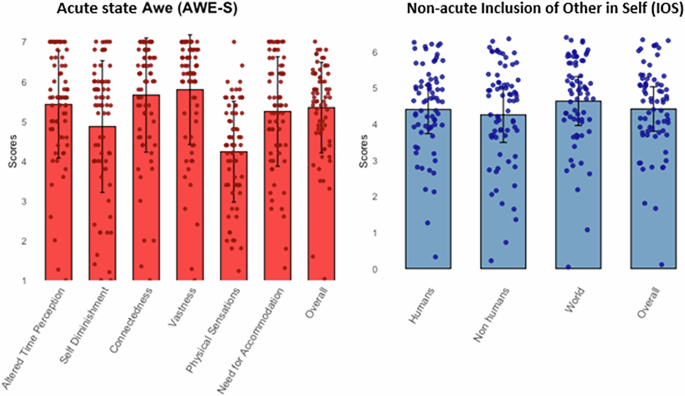
Descriptive statistics for IoS measures and AWE-S components are represented in Fig. 1. Participants reported moderate to high levels of overlap between the self and other (IoS measures referring to non-acute state) and substantial awe experiences (referring to acute trip state), across all AWE-S subscales. The IoS Overall measure demonstrated a mean of 4.44 (SD = 1.26), reflecting significant overlap across categories.

Means (bars), Standard Deviations (lines) and Data Distributions (dots) for AWE-S (acute) and IOS (non-acute) measures.
Correlation analysis between awe and inclusion of others in the self
Pearson correlation analyses revealed significant relationships between IOS (non-acute) measures and AWE-S (acute) components. To account for multiple comparisons, we applied the False Discovery Rate (FDR) correction using the Benjamini-Hochberg procedure.
The IOS Overall (non-acute) measure was significantly positively correlated with AWE-S (acute) Connectedness (r = 0.329, padjusted = 0.002), Vastness (r = 0.377, padjusted = 0.003) and with Overall Awe (r = 0.267, padjusted = 0.047) (Fig. 2). These results indicate that higher perceptions of self-other overlap are associated with stronger awe experiences, particularly in terms of connectedness and vastness.

Pearson correlations between IoS non-acute measures and acute AWE-S components with FDR correction. Note. * = p ≤ .05, ** = p ≤ .01, FDR-corrected.
Qualitative analysis of the written narratives of lasting changes
90 participants provided written accounts of the changes they experienced following their psychedelic trip.
Meta-theme 1: nature of acute experience
Following completion of the AWE-S scale retrospectively referring to their trip, participants were asked to share additional reflections on their acute psychedelic experience. Sixty-seven provided responses, with ten themes emerging. The most common, Emergence of Insights and Purpose (23%), involved increased clarity and direction. Sense of Oneness and Connectedness (20%) described a profound unity with everything, while Suffering, Death, and Challenging Experiences (16%) captured distressing or overwhelming effects.
Other themes reflected encounters with something beyond the ordinary. Experience of Something Greater Than Oneself (13%) described perceived guidance from an external wisdom, while Positive Emotions (12%) included feelings of love, bliss, and awe. Sense of Profundity or Higher Reality (10%) involved the perception of hidden aspects of reality, and Religious or Spiritual Experience (8%) reflected newfound spiritual awareness. Additional themes included Themes of Nature (7%), Expansion and Wholeness of Self (7%), and Questioning the Nature of Reality (7%), reflecting altered perceptions of self, nature, and existence. Example quotes are presented in Supplementary Table 1.
Post-experience epistemic changes
Meta-theme 2; Intrapersonal changes: changes to understanding of self
Seventy-nine participants (88%) reported changes in their understanding of the self, reflecting shifts in self-awareness, values, and relational perspectives. Thematic analysis identified eight interrelated themes; These include Greater Self-Insight (42%), characterized by increased self-awareness and recognition of personal patterns; Increased Compassion (24%), marked by greater kindness toward oneself and others; and a Shift in Purpose and Values (23%), reflecting re-evaluations of priorities and moral orientations. Some described an Increased Awareness of Wholeness and Complexity (17%), seeing themselves as multifaceted and shaped by conditioning, while others reported Increased Authenticity (11%), feeling more aligned with their true desires. Some reported general improvements in Wellbeing (8%), whereas Increased Awareness of Oneness (8%) reflected a dissolution of self-boundaries. A minority (3%) reported significant Negative Repercussions of Change, struggling with distressing insights. Example quotes are presented in Supplementary Table 2.
Meta-Theme 3: interpersonal changes: Changes to understanding of others
Seventy-three participants (81%) reported changes in their understanding of others, reflecting shifts in empathy, perspective-taking, and relational awareness. Thematic analysis identified six interrelated themes. The most common, Increased Empathy (28%), involved a heightened ability to understand and forgive others, often accompanied by Increased Acceptance of Difference (24%), where participants recognized that individuals construct and interpret the world in unique ways. Awareness of Commonality in Human Experience (23%) emerged as participants acknowledged shared struggles and emotions, while Interrelatedness (21%) reflected a broader recognition of interconnectedness and the relations between parts, shifting from an “us vs. them” mentality to a more unified perspective. Increased Compassion (18%) was reported as a deepened sense of kindness and consideration for others, while Sense of Sonder (10%) captured the realization that others are complex, whole individuals with their own inner worlds. Example quotes are presented in Supplementary Table 3.
Meta-Theme 4: transpersonal changes: changes to understanding of reality
Seventy-four participants (82%) reported changes in their understanding of reality, reflecting shifts in metaphysical, existential, and epistemological perspectives. Thematic analysis identified ten interrelated themes. The most common, Increased Sense of Animism (29%), involved perceiving nature as more alive and communicative. Increased Awareness of the Subjectivity of Reality (18%) followed, with participants recognizing reality as perspectival rather than absolute. Some experienced a Shift in Life Purpose and Values (11%), while others described a heightened sense of Interrelatedness (9%), perceiving deeper connections across systems and existence. Several themes reflected changes in belief frameworks. Reductionism Reduction (9%) marked a move away from strictly physicalist perspectives, while Increased Religiosity (9%) indicated shifts toward faith or spiritual conviction. Some reported an Increase in Philosophical Inquiry (9%), engaging more deeply with existential and metaphysical questions, or Increased Openness and Curiosity (8%), returning to a more exploratory, childlike perspective. Perception of Mortality (7%) often shifted toward reduced fear of death, while Increased Agnosticism (6%) reflected greater uncertainty about prior beliefs. A small minority (2%) reported significant Negative Change, describing distressing and destabilizing shifts in worldview. Example quotes are presented in Supplementary Table 4.
Meta-theme 5: Changes to understanding of ‘normal’
Seventy-one participants (79%) reported changes in their understanding of ‘normal,’ reflecting shifts in its boundaries, origins, and significance. Thematic analysis identified nine interrelated themes. The most common, Greater Acceptance of Difference and Other Perspectives (22%), involved recognizing that what is considered normal varies across individuals and contexts. Seeing Normality as a Social Construct (21%) emphasized that norms are shaped by cultural and societal conditioning rather than inherent truths. Some described an Expanded Concept of Normality (20%), broadening their sense of what is possible and acceptable.
Other themes reflected deeper ontological and epistemic shifts. Complexity Awareness (17%) involved a recognition of the fluid and multifaceted nature of human perception, while Metaphysical Resonance (11%) captured an increased sense of sacredness or divine reality. Some participants described Rejecting Normal (8%), rejecting the concept entirely as a limiting construct, while others reported a strengthened Nature Connection (7%) and Interrelatedness (4%), seeing normality in terms of interconnected systems rather than fixed societal expectations. A small minority (2%) reported Negative Changes, describing paranoia and heightened fear responses. Example quotes are presented in Supplementary Table 5.
Meta-theme 6: Changes in intuition
Sixty-eight participants (76%) reported changes in their intuition, reflecting shifts in how they experience, trust, and apply it. Thematic analysis identified seven interrelated themes. The most common, Greater Guidance and Attunement to Intuition (21%), involved participants relying more on intuition to navigate decisions and feeling a stronger connection to their inner sense of truth. Greater Trust and Faith in Intuition (18%) reflected an increased willingness to trust intuition as part of a broader sense of surrender to life’s unfolding. Shift in Purpose and Values (17%) captured how intuitive insights led participants to reassess priorities, often letting go of material concerns or control over external circumstances. Other themes suggested a widening of intuitive perception. Interrelatedness (14%) appeared in changes to relationships, particularly in family dynamics, where intuition fostered a sense of gratitude and reciprocity. Metaphysical Resonance (13%) reflected an intuitive openness to spirituality, sacredness, or the presence of a divine force. Openness (10%) described feeling more receptive and mindful, while Greater Alignment with Self (9%) involved deeper bodily and emotional awareness. Additional themes included Complexity Awareness (8%), Nature Connection (7%), and Empathy (6%), while a small minority (4%) reported Negative Change, describing distressing or disorienting shifts. Example quotes are presented in Supplementary Table 6.
Meta-theme 7: Changes of boundaries between self and world
Seventy-two participants (80%) reported changes in their perception of boundaries between their self and the world following their transformative psychedelic experiences. Thematic analysis identified six themes. The most common, Interrelatedness (30%), reflected a heightened sense of interconnection, with participants describing understanding everything plays a role and has a place in a greater whole. Malleability (12%) captured perceptions of self-world boundaries as fluid and changeable. Some participants dismissed Boundaries as Illusory (11%), expressing the view that self-world divisions are temporary perceptions rather than inherent realities. Boundlessness (10%) described the removal of borders and boundaries in their perception, while Oneness (10%) reflected a more nuanced sense of unity, where participants expressed awareness that they are metaphysically indistinct from their surroundings. A minority (2%) reported Increased Disconnection, describing a shift in the opposite direction where their experiences led to feelings of isolation or detachment. Example quotes are presented in Supplementary Table 7.
Meta-theme 8: Vulnerability during the experience
Sixty-four (71%) participants experienced increased feelings of vulnerability during their transformative psychedelic experience. Sixteen (18%) experienced no increase and 10 did not respond. Seventeen (19%) participants did not specify the valence of this increase, 8 (9%) reported a positive experience of vulnerability, 9 (10%) reported both positive and negative experience of vulnerability, while 17 (19%) reported a negative experience of vulnerability during their transformative trip (e.g. Yes, I was very confused and scared at times. Had a difficult time grasping what was going on and felt that the world was a scary place).
Meta-theme 9: Post-experience vulnerability
Forty (44%) participants experienced increased feelings of vulnerability following their transformative psychedelic experience. Eight (9%) reported positive outcomes of vulnerability, 9 (10%) reported a mix of positive and negative outcomes, while 11 (12%) reported significant negative effects of their increased vulnerability (e.g. Yes, I lost complete sense of self and had trouble talking to even my closest friends). Fourteen (16%) did not specify the valence of this increase.
Meta-theme 10: Managing uncertainty
Participants were asked whether they struggled more or felt better equipped to manage the unexpected, following their transformative experience. Fifty-one participants (57%) felt better equipped to manage the unexpected, while 3 (3%) were struggling more. Fifteen (17%) responded that they struggled more in some cases and felt better equipped in others.
Meta-theme 11: Stability of understanding the experience
Participants were asked whether their understanding of their experience remained stable over time. 23 (26%) participants reported their understanding remained stable, 49 (54%) reported their understanding changed with time, while 11 (12%) of participants identified both changing and stable parts within their understanding.
Meta-theme 12: Sharing the experience with others
Participants were asked whether they talked to others about their experience and how this affected them. For 36 (40%) participants, sharing their experienced with others helped them, 13 (14%) experienced mixed effects of sharing, while 4 (4%) found sharing hurt them in some way (e.g. Yes, my family, friends and work colleagues, this resulted in being fired from work). Twenty-one (23%) did not specify how their sharing affected them.
Thematic network analysis
The 34 themes relating to post-experience epistemic shifts that were identified through the Structured Tabular Thematic Analysis were included in the thematic network analysis graph. Three overarching clusters of epistemic shift themes were identified through the Thematic Network Analysis.
Figure 3 shows the thematic network with the 34 themes, illustrating the overarching clusters and their connections: Dissolution of societal and natural boundaries (orange), Expanded awareness and openness to the complexity of reality (purple), Increased prosociality, compassion and acceptance of difference (green).

Node size represents theme frequency (weighted degree); line thickness indicates co-occurrence frequency (edge weight). Abbreviations in brackets denote origin question: S= Understanding of self; O= Understanding of others; R=Understanding of reality; I= Changes in intuition; N= Understanding of normal; B= Understanding of boundaries of self and world; M= themes occurring across multiple questions.
The 14 themes within this thematic cluster (Table 3) reflect participants’ heightened awareness of the complexity of reality, paired with an increased openness to uncertainty and ambiguity, and to the supernatural.
Participants frequently described that their understanding of what is normal had expanded, which correlated with their increased awareness of the complexity of reality, intuitive openness and resonating with metaphysical ideas and experiences such as supernatural phenomena. This resonance, in turn, cooccurred with participants’ increased alignment with their intuition, an awareness of the malleable nature of reality’s boundaries and increased awareness of the commonality in human experiences. Descriptions of intuitive openness also cooccurred with agnosticism, a sense of uncertainty about the nature of reality. Sonder (an appreciation of others as having fully fledged independent realities), had some connections with agnosticism but also to increased wellbeing and feelings of disconnection and other negative changes. Negative change had some cooccurrences with religiosity, which in turn related to metaphysical resonance, an expanded concept of normal, and a sense of the illusory nature of reality’s boundaries.
The 10 themes in this cluster (Table 4) primarily capture participants’ experiences of profound shifts in their perception of boundaries—both internal and external. These shifts point to a reconfiguration of the perceived separation between self and world.
Participants frequently described that their experiences led them to significant insight about themselves, which coincided with an increased awareness of the socially constructed nature of reality and which, in turn, along with oneness and an appreciation of the subjectivity and many perspectives on reality, strongly related to a newfound purpose and redefined values in life.
Participants’ new insight about themselves most frequently cooccurred with their understanding of interrelatedness, oneness, and boundlessness, where they reflected on their unity with the rest of the world and the relationships between them and other parts of an ‘interconnected web of reality’. This interrelatedness also frequently co-occurred with an understanding of the subjectivity of reality, which co-occurred with the rejection of the concept of normal and empathy, an increased emotional understanding of others and their perspective, and with increased connection to the natural environment.
The 10 themes within this cluster (Table 5) highlight participants’ transformations in their relationships with others and their worldview. These changes were marked by an increased capacity for compassion, acceptance of difference, trust and faith in intuitive guidance, and a deepened philosophical and existential curiosity.
Participants frequently described heightened feelings of compassion, both towards themselves and others. These descriptions of compassion are strongly related to the second cluster’s theme of complexity awareness, also reflected in the high betweenness centrality of the thematic code. Compassion descriptions cooccurred in high frequency with an acceptance of difference and different perspectives, an increased perception of animism, spirits and entities, attunement to, and trust and faith in intuition, and a reduction in reductionist lenses for understanding reality.
Increases in compassion were also strongly linked to the second cluster’s theme of oneness and cooccurred, albeit less frequently, with increased authenticity, open-mindedness, a shift to a more accepting perception of mortality and increased philosophical enquiry.
link