Single and combined effect of beetroot juice and caffeine intake on muscular strength, power and endurance performance in resistance-trained males
Participants
Thirteen male resistance-trained individuals (age, 23.8 ± 4.9 years; body mass, 73.4 ± 7.8 kg; training experience, 4.6 ± 3.3 years and 4.6 ± 1.3 sessions/week; bench press (1RM/kg body mass), 1.25 ± 0.3; back squat (1RM/kg body mass), 1.85 ± 0.4) participated in this study being recruited in a 2 month period of time.
The inclusion/exclusion criteria for this study were as follows: (a) participants aged between 18 and 35 years; (b) absence of neuromuscular, musculoskeletal, neurological, immunological, or cardio-metabolic disorders; (c) a minimum of 8 months of experience in resistance training, with a training frequency of at least 3 days per week over the past 3 months, as confirmed by a questionnaire; (d) no use of tobacco54, vaper, or taking any medication known to interfere with stomach acid production, drug, stimulant or any other sports supplement during the trial that may interfere neuromuscular performance. Consumption of caffeine was not considered an inclusion or exclusion criterion; however, in the pre-trial 24-h recall, participants reported a caffeine intake of 6.9 ± 6.2 mg/kg/day, classifying them as high caffeine consumers55.
Before study enrolment, all procedures potential risks or discomfort associated with the experiments were explained to participants, and after solving any doubts related to the experiment, they gave their written informed consent. The study design and protocol adhered to the tenets of the Declaration of Helsinki and was approved by the University Ethical Committee of Investigation (CEIP/2023/4/093) and registered at ClinicalTrial.gov (NCT06596395).
Experimental design
The study design was randomized, triple-blind, cross-over and placebo-controlled. Participants reported to the laboratory on 5 occasions at the same time of day (± 0.5 h) to avoid the potential influence of circadian rhythms on neuromuscular performance. During the first visit, participants underwent preliminary questionnaires of dietary and physical activity habits and body composition assessments, and a familiarization session where they experienced all tests performed in the trials. During visits two to five, participants were assigned to four conditions: (a) Caffeine (CAF); (b) Beetroot juice (BJ); (c) Caffeine plus beetroot juice (CAF + BJ); (d) Placebo (PLA). The experimental protocol is illustrated in Supplementary Fig. 1. Each trial was separated by 3 to 7 days. The order of the trials was randomized according to each participant’s experimental condition (www.randomized.org). An external researcher elaborated the alphanumeric code assigned to each sequence to blind participants and researchers during the trials. The codes were unveiled after statistical analysis to blind statistician.
Experimental protocol
Body composition, dietary and physical activity habits
Body composition was assessed using electric bioimpedance (Tanita MC-780MA, Tanita Corporation of America Inc. IL, USA). Dietary habits were analyzed using a 24-h dietary recall (i.e., Spanish Food Composition Database (BEDCA) and CESNID Food composition data tables) while physical activity habits were evaluated using the International Physical Activity Questionnaire (IPAQ). Dietary habits (energy intake, 2489 ± 759 kcal; protein, 1.92 g/kg; carbohydrate, 3.33 g/kg; fat, 1.28 g/kg), physical activity habits (physical activity, 4983 ± 457 METs-min/week; sedentary time, 6.4 ± 2.8 h/day) were replicated in the 24 h before each trial. Moreover, 24 h before the familiarization session and until the end of the trial, participants were encouraged to refrain from stimulants and alcohol intake. Participants were also instructed to abstain from all caffeine-containing foods, beverages, and supplements for 24 h before each testing session to minimize potential variability related to habitual caffeine intake and to standardize baseline caffeine levels across conditions. Besides, Dietary NO3− intake was restricted by providing subjects with a list of foods rich in NO3− (e.g., beetroot, celery, or spinach) that they should avoid in the 48 h before each trial session. Participants were encouraged to avoid brushing their teeth or using any oral antiseptic rinse, or chewing gum or ingesting sweets that could alter their oral microbiota and interfere with NO3− reduction during the 24 h leading up to each experimental trial56.
Supplementation protocol
The supplementation protocol started 180 min before the trial. Participants ingested 70 mL of concentrated NO3−-rich (BJ, 6.5 mmol NO3−) or NO3−-depleted (PLA, ~ 0.04 mmol NO3−) beetroot juice (Beet IT; James White Drinks Ltd., Ipswich, UK). Then, 60 min before the trial, participants ingested caffeine (CAF, 3 mg/kg, HSN, Granada, Spain) or placebo (PLA, 3 mg/kg, maltodextrin), dissolved in 150 ml of tap water adding a flavoring with no calories to mask the supplements’ flavor and smell (MyProtein, Northwich, UK). The beverages were provided in opaque shaker bottles.
One-repetition maximum (1RM)
1-repetition maximum (1RM) of bench press and back squat exercises were obtained during the first visit to determine the load (kg) corresponding to 25%, 50%, 75%, 90% and 100% 1RM for each participant in a Smith machine (Multipower, Technogym, Spain). The 1RM protocol was initiated with a load set at 20 kg. This load was increased by 15–10 kg until mean velocity (Vmean) reached 0.2 m/s in bench press and 0.4 m/s in back squat using a linear transductor (Encoder, Chronojump Boscosystem, Spain)19. Then, smaller increments (< 5 kg) were adjusted to determine the 1RM. After 20 min of passive recovery, participants carried out a familiarization session, performing the same test in the same order as in the experimental trials.
Muscular strength and power
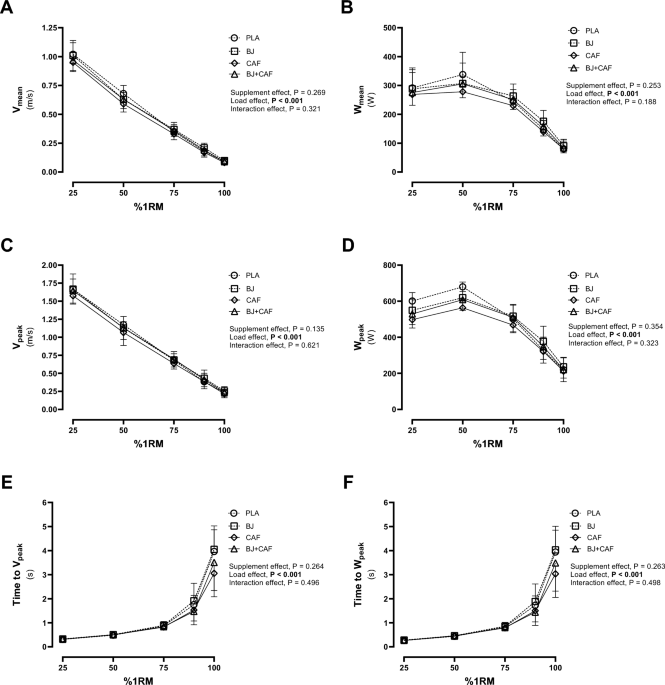
After a standardized warm-up of 10 min of dynamic stretches and joint mobilization exercises, the participants initiated the muscular strength and power test. The test consisted of the measurement of bar velocity displacement in a Smith machine (Multipower, Technogym, Spain), with a linear encoder attached to the bar (Encoder, Chronojump Boscosystem, Spain) to measure muscular mean, peak and time to reach peak velocity (Vmean, Vpeak and Time to Vpeak) and power output (Wmean, Wpeak and Time to Wpeak) at five incremental loads 25%, 50%, 75%, 90% and 100% 1RM for bench press and back squat exercises. On each trial, three attempts were executed to 25%1RM, two to 50%1RM and one for 75%, 90% and 100% 1RM. On each attempt, participants were instructed to perform the eccentric phase in a controlled manner, pause for 2 s in the isometric phase, and then execute the concentric phase at the maximal velocity possible, ensuring a similar range of movement for each exercise57. Three minutes of passive recovery were allowed between sets and exercises.
Muscular endurance
Participants were required to complete one set at 65% 1RM in bench press and back squat exercise, performing as many repetitions as possible until task failure. The order of the exercise types and loads was always the same on each trial. On each attempt, participants were instructed to perform the eccentric phase in a controlled manner, pause for 2 s in the isometric phase, and then execute the concentric phase at maximum velocity, ensuring a similar range of movement for each exercise. Each set or exercise was interposed by 5 min of passive recovery. The number of repetitions, as well as mean, peak and time to reach peak velocity and power output were obtained from each repetition and averaged. On each participant, the number of repetitions selected to average velocity and power variables were the lower performed on any of the experimental conditions.
Isometric strength and vertical jump test
The isometric handgrip and isometric mid-thigh pull tests were performed using handgrip and back/legs dynamometers (Grip-D, Takei, Japan). Each test was repeated two times, maintaining maximal muscular tension for five seconds on each attempt and allowing 30 s of passive recovery and the best attempt performed was recorded for subsequent analysis.
Vertical jump ability was assessed using countermovement jump (CMJ, without arm swing) tests performed on a force platform (Kistler 9229A, Winterthur, Switzerland). Participants completed three attempts for each test, allowing one minute of passive recovery and recording the average and best attempt performed by each participant.
Questionnaires and scales
At the end of the familiarization and the trials, participants were required to fill out a questionnaire about their perception of power, endurance, energy and exertion, as well as heart, muscular and gastrointestinal discomfort. This questionnaire included a 1- to 5-point scale to assess each item. Participants were previously informed that 1 point meant the minimal amount of that item and 5 points meant the maximal amount of the item. Moreover, Participants’ mood was assessed using a reduced version of the profile of mood states questionnaire (POMS)20. Participants graded a set of 29 items related to the mood on a Likert scale from 0 (not at all) to 4 (extremely) in reply to the question “How do you feel at this moment?” to assess six scales: tension, depression, anger, vigor, fatigue and confusion. Additionally, a specific question to evaluate the blinding procedure was also included.
Statistical analysis
The sample size calculation revealed that 12 participants were sufficient for the purpose of the study to show an effect size of 0.45 (α = 0.05; 1 − β = 0.80) (v3.1, G*power, Dusseldorf University, Germany); finally, 14 participants were recruited and finally 13 took part in the investigation.
Data collected in the study were analyzed using the statistical package SPSS v29.0 (SPSS Inc., Chicago, IL, USA) and figures were generated using GraphPad Prism (v8, GraphPad Software Inc., La Jolla, CA, USA). Firstly, the Shapiro–Wilk test was used to assess whether the data followed a normal distribution. At a significance level (α) of 0.05, the resulting p-value was greater than 0.05, indicating that the assumption of normality was not violated. Muscular strength/power was analyzed using a two-way ANOVA for repeated measures according to supplements (CAF, BJ, CAF + BJ and PLA), load (25, 50, 75, 90 and 100%1RM) for each exercise type. Muscular endurance was analyzed using a one-way ANOVA for repeated measures according to supplement (CAF, BJ, CAF + BJ and PLA) using the only load measured (65%1RM) for each exercise type. Mauchly’s test of sphericity was conducted to assess the assumption of sphericity required for repeated-measures ANOVA. When the assumption of sphericity was violated (i.e., P < 0.05), the degrees of freedom were corrected using the Greenhouse–Geisser adjustment. In cases where the Greenhouse–Geisser epsilon exceeded 0.75, the Huynh–Feldt correction was applied. Holm-Bonferroni correction was used as a post hoc test when the main or interaction effect was identified in the ANOVA and when pairwise comparisons were conducted. Finally, the McNemar test was also used to detect differences in side effects after beverage intake.
Values are reported as mean ± standard deviation (SD). The significance level was set at P < 0.05. Effect size (ES) was calculated as partial eta squared statistic (ηp2) for the two-way repeated measures and Hedges’s (g) for partial comparisons.
link