USF ranks among top 20 public universities for new patents in 2025
by Ann Comer-Woods, USF Research
The University of South Florida has reaffirmed its position as one of the nation’s
most innovative research institutions, earning a place among the top 20 public universities
for producing U.S. utility patents, according to annual rankings released today by the National Academy of Inventors. For more than a decade, USF
has consistently appeared in this elite group, demonstrating its long‑standing strength
in research, invention and technology commercialization. Based on the 81 new patents
secured in 2025, USF is 18th among U.S. public research universities, 27th among all
U.S. public or private universities and 41st among universities worldwide.
“At the University of South Florida, we are dedicated to fostering an environment
where innovation thrives and where our discoveries have a meaningful impact on our
region, our state, our nation and globally,” USF President Rhea Law said. “This achievement
reflects the creativity of our world-class faculty, staff and students, whose transformative
ideas are shaping the future.”
“USF’s continued success as one of the nation’s top producers of U.S. utility patents
reflects the unwavering creativity, dedication and impact of our research community,”
USF Provost Prasant Mohapatra said. “Each patent represents a solution that improves
lives here in Florida and around the world.”
The Top 100 Worldwide Universities Granted U.S. Utility Patents in 2025 report from
the National Academy of Inventors uses data from the U.S. Patent and Trademark Office
in the previous calendar year and highlights the vital role patents play in not only
university research and innovation, but in the global knowledge economy.
The three universities in the Florida High Tech Corridor—USF, University of Florida and University of Central Florida—collectively secured
285 patents, placing the corridor ahead of nationally recognized centers of innovation,
including North Carolina’s Research Triangle and the University of Texas System.
Below are some of USF’s 2025 patent highlights:
- Denis Karaiskaj, a professor in the Physics Department, has created a silicon-based, solid-state,
miniaturized atomic clock that is a smaller, cheaper and more energy efficient alternative
to the chip-size atomic clock that is currently used in electronic navigation devices.
Awarded a Foundation Bull Ring Ring Accelerator Grant in 2025, the device has applications for oil and gas exploration, space navigation,
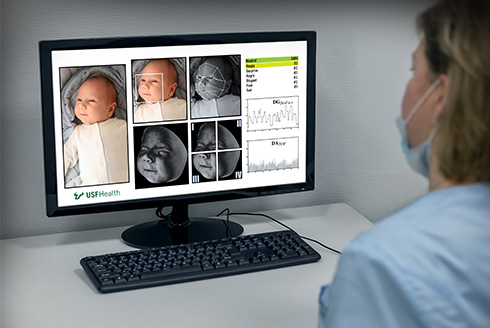
military GPS and high-end automotive and watch manufacturing. - A multidisciplinary team of USF researchers has developed a new way to measure pain in newborns following surgery. The invention uses a camera and microphone to record a baby’s face, body movements
and sounds, then applies advanced machine‑learning techniques to analyze these signals
and the vital signals. If parts of the baby’s face or body are blocked from view,
the system can reconstruct the missing information using a generative model and combine
all available signals to estimate the baby’s pain level continuously and objectively.
This produces a real‑time pain score that helps clinicians recognize postoperative
pain earlier, reduce reliance on opioids and improve care for vulnerable infants who
cannot communicate their discomfort. The current research team includes Bellini College
of Artificial Intelligence, Cybersecurity and Computing Professors Dmitry Goldgof
and Yu Sun, Morsani College of Medicine Associate Professor Thao “Tina” Ho, College
of Public Health Professor Yangxin Huang, computer science and engineering doctoral
students Md Imran Hossain, Jacqueline Hausmann and Anthony McCofie, and medical collaborators
Kanwaljeet S. Anand and Melissa Scala at Stanford Children’s Hospital and Stephanie
M. Prescott at Inova Hospitals. The team also collaborate with industry partners SRC
Biosciences and GE Healthcare.
- Gray Mullins, a professor in the Department of Civil & Environmental Engineering, and post-doctoral
researcher Tristen Mee have invented a measurement system that verifies the dimensions
of concrete foundations while they are being poured, eliminating the long delays of
current temperature‑based testing methods. Using a motor-controlled cable with a probe
on the end, along with sensors that track the probe’s movement and tension as it touches
the top concrete while filling an excavation, construction crews can detect and correct
issues during the pour instead of days later, improving efficiency, safety and overall
quality. - Professor Joseph Walton, who holds a joint appointment in the College of Behavioral and Community Sciences
and the College of Engineering, has patented a new class of drug compounds to treat
tinnitus (ringing in the ears). The drugs, which can be delivered orally or via sustained‑release
transdermal patches, reduce the abnormal neural hyperactivity in the central auditory
system that contributes to this neurological condition. - Yu Zhang, a professor in the Civil and Environmental Engineering Department and program director
of Advanced Air Mobility at the Center for Urban Transportation Research, has developed
a smart computer system that uses advanced artificial intelligence to help manage
air traffic at multiple airports. It tracks detailed, map-based weather data, learns
how weather affects airport operations and produces real-time predictions that air
traffic controllers can use to more accurately predict which runways each airport
should use and how many planes they can safely handle each hour.
link