Effects of reformer pilates on body composition, strength, and psychosomatic factors in overweight and obese women A randomized controlled trial
Study design
This study was designed as a randomized controlled trial study. The participants were randomly assigned to 2 groups, i.e., the exercise group (EG) and control group (CG). All evaluations and exercises in the study were performed at the Eastern Mediterranean University Sports Health Unit.
Participants
A total of 47 overweight and obese women who met the inclusion criteria were evaluated.
The inclusion criteria for this study were as follows: age between 30 and 60, with a sedentary lifestyle, individuals who do not control their diet, physical activity levels, and a BMI of 25 kg/m² and above. The physical activity levels of the individuals included in the study were determined using the International Physical Activity Questionnaire. Only female individuals were included in the study because obesity and overweight are more common in women than in men21. Patients were excluded from the study if they had any of the following criteria: Diagnosis of neurological, cardiovascular, or psychological problems, those who had a musculoskeletal system injury in the last year, regular medication users and individuals who participated in any regular physical activity program in the last 6 months were excluded from the study. Written and verbal consent was obtained from patients who met the inclusion criteria and the procedure was explained by the researcher. Before the study, informed consent was obtained from all subjects. This study was approved by the Eastern Mediterranean University Ethics Committee in April 2021 (numbered 2021/02). Clinical trial registration number: NCT05176912 (04/01/2022). This study was conducted by the Declaration of Helsinki guidelines.
Sample size calculation
In the study conducted by Rayes et al. in 2019, titled “The effects of Pilates vs. aerobic training on cardiorespiratory fitness, isokinetic muscle strength, body composition, and functional tasks outcomes for individuals who are overweight/obese: a clinical trial, “22 the primary outcome was the change in body fat percentage, and the effect size was determined to be f = 0.825. Accordingly, assuming that the effect size in our study would be high, the required sample size was calculated as 47 participants based on a 95% power (1-β = 0.95), an effect size of f = 0.80, and a significance level of α = 0.05, using the G*Power 3.1.9.2 software23.
Randomization and blinding
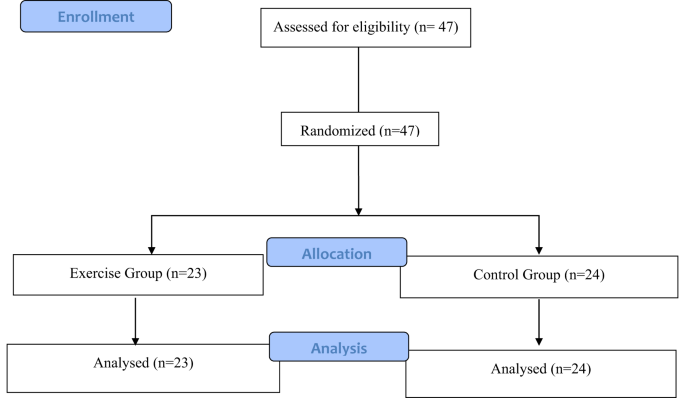
Patients who met the inclusion criteria were randomly allocated to the EG or CG using GraphPad software and a simple randomization technique. As a result of randomization, 23 participants were included in the EG and 24 participants were included in the CG (Fig. 1). All the volunteers were blinded and did not know the groups to which they belonged. The risk of selection bias was minimized due to the simple randomization technique used for randomization. However, the outcome assessors were not blinded.

Flow diagram showing the flow of participants through each stage of trial.
Intervention
Exercise group
The EG was given the RP exercise program under the supervision of a physiotherapist for 50–60 min, 3 days a week for 8 weeks. Before the first training session, a practice session was held to familiarize the volunteers with the Reformer machine, the exercises to be performed, and the six principles of the Pilates method. The exercise program was carried out in three stages: warm-up (10 min), exercise training (40 min), and cool-down (10 min) periods. The intensity of the program was progressively increased by applying beginner level for 1–2 weeks (Single leg stretch, double leg stretch, swimming, obliques (Fig. 2), spine twist, spine stretch forward), intermediate level for 3–6 weeks (Roll-up, hundred (Fig. 3), side bend, side leg series, scooter (Fig. 4), footwork toes, single leg series, double leg series), and advance level for 7–8 weeks (Hundred, side kick (front/back), rowing, swan, teaser (Fig. 5), side bend, side kick (small circles)) to participants. At the beginner level, exercises were performed with 2 sets of 10 repetitions using green and yellow springs. Intermediate-level exercises were performed using green and blue springs for 2 sets of 12 repetitions, and advanced-level exercises were performed using green and blue springs for 2 sets of 15 repetitions. All exercise sessions were performed with musical accompaniment.


Control group
Participants in the CG were also informed about the study, and their consent was obtained. The control group, unlike the experimental group, agreed not to receive any treatment or intervention. Generally, taking into account that the control group does not receive any treatment, the health status and changes in the individuals of the group were monitored. The CG consisted of participants who received no intervention, did not engage in exercise, and did not make any changes to their dietary habits throughout the study period. Individuals in this group continued their natural lifestyle.
Outcome measures
All results were measured by the same physiotherapist before treatment and at the end of the 8th week of the intervention.
Sociodemographic evaluation
Age, gender, sports habits, alcohol, cigarette, and drug consumption of the individuals were questioned. Moreover, body composition (body weight, BMI, and body fat percentage) was measured with a bioelectrical impedance device (InBody 270). The heights of the individuals were measured with a tape measure and recorded in meters. During the day, body weight may vary depending on water balance, so each measurement was taken at the same time and on an empty stomach. Participants were instructed to refrain from eating at least 4 h before the measurement and to discontinue fluid intake at least 2 h before the assessment. In addition, measurements were taken before exercise, as measurements taken immediately after exercise may be misleading due to factors such as muscle swelling and water retention. Participants wore light clothing and removed metal items like buckles, jewelry, and belts during the measurements.
Upper extremity muscle strength
Handgrip strength is considered an indicator of overall muscle health and physical strength. A handgrip dynamometer was used to evaluate upper extremity muscle strength. To do the test, the participants were asked to sit upright in a chair with back support. The person was prepared with the knee and hip at 90⁰ flexion, the forearm in neutral position, and the wrist in 0–30⁰ extension. During the measurement, the person was asked to squeeze the handles of the dynamometer as strongly as possible. 3 measurements were made at 1-minute intervals. As test results, the average values of the measurements were taken and recorded in ‘kg’24.
Muscle endurance
The McGill Muscular Endurance Test is a set of four isometric endurance tests designed to assess the ability of the trunk muscles to stabilize the spine under static, loaded conditions. These tests include trunk flexion, extension, and left and right lateral flexion endurance. The tests are timed, and the duration the participant can maintain the prescribed position is recorded25.
Sleep quality assessment
The Pittsburgh Sleep Quality Index (PSQI) was used to assess sleep quality. The PSQI includes a total of 24 questions, 19 of which are self-assessment questions and 5 of which are answered by the individual’s spouse or a roommate. These items create 7 component scores: sleep quality, sleep latency, sleep duration, habitual sleep activity, sleep disturbance, sleep medication use, and daytime dysfunction. Higher scores indicate worse subjective sleep quality26.
Anxiety and depression assessment
The Hospital Anxiety and Depression Scale (HADS) was used to assess anxiety and depression. This self-administered rating questionnaire consists of 14 items, 7 related to anxiety and 7 to depression. The items in the scale are evaluated on a 4-point Likert scale and are based on a scoring system between 0 and 3. It is stated that for each subscale, 0–7 points are the normal range, 8–10 points suggest the presence of a mood disorder, and 11 and above points indicate a possible mood disorder. Additionally, there are recommended points as mild (8–10 points), moderate (11–15), and severe (16 and above) cases27.
Statistical analysis
Data were analyzed using the Statistical Package for Social Sciences (SPSS) 27.0 software. Before statistical tests were used, the normal distribution assumptions of the data were checked with the Shapiro–Wilk test, and it was determined that they conformed to normal distribution. The distribution of the participants according to their socio-demographic characteristics was examined with frequency analysis and shown in cross tables. The mean (x) ± standard deviation (SD) as appropriate, was calculated for each variable. Statistical significance was set at p-value < 0.05. In this context, the Analysis of Covariance (ANCOVA)28 was applied to compare the changes in pre-test and post-test body composition, muscle strength, endurance, and psychosomatic measurements of the exercise and control group participants. In the ANCOVA analysis, the effect size was assessed using eta squared (η²). According to Cohen’s classification, an η² value below 0.01 is considered negligible, between 0.01 and 0.06 indicates a small effect, between 0.06 and 0.14 indicates a medium effect and values equal to or above 0.14 indicate a large effect.
link